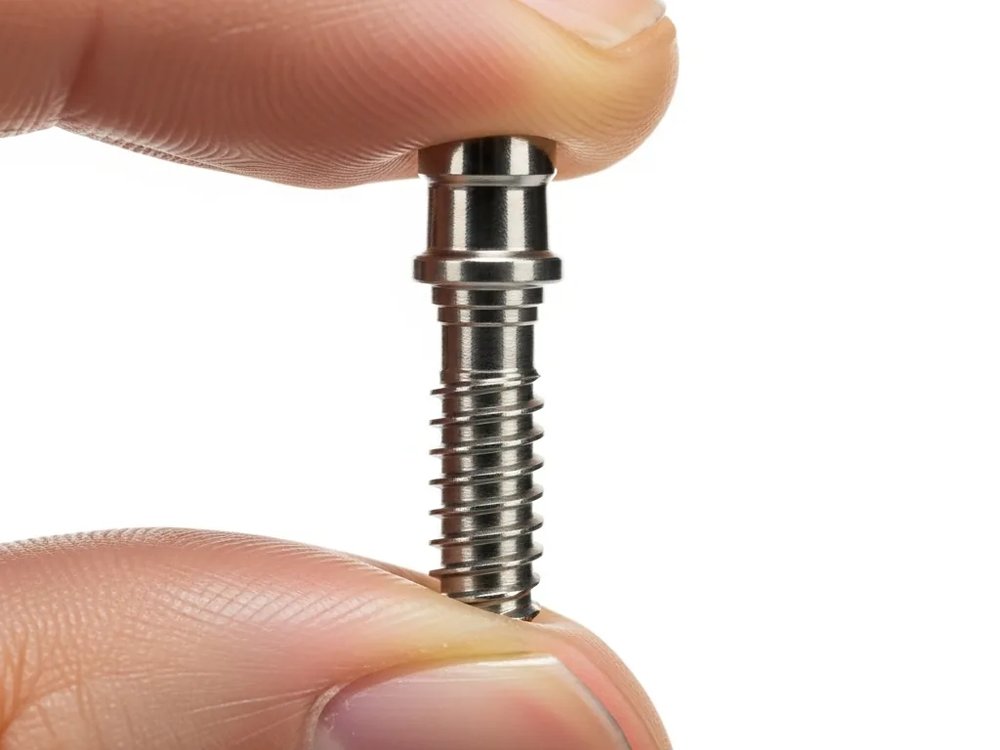
Dental implants — artificial tooth roots made of titanium
Dental implants are usually made of high-purity titanium.
High biocompatibility
Unlike other materials, titanium forms a direct molecular bond with bone. The rough surface of the titanium implant plays a particular part in this. On contact with oxygen a protective oxide layer forms on the titanium surface.
No allergies to commercially pure grade 4 titanium are known.
| O | 0.45 % max. |
| Fe | 0.30 % max. |
| C | 0.10 % max. |
| N | 0.05 % max. |
| H | 0.015 % max. |
| Titanium | balance |
Titanium implants reach the limits of what they can bear when their diameter is reduced. A reduced-diameter implant offers less surface area
for osseointegration, which can lead to complications under unfavourable loads. The new titanium-zirconium alloy (TiZr) Roxolid was therefore developed for implants with less surface area – reduced-diameter and shorter implants.
Material
Titanium as a material
Implants are artificial tooth roots. Alongside the design of the implant, the material is one of the most important factors for success. Since they were first developed, implants have been made of pure or high-purity titanium, which the body accepts like its own tissue. The reasons for preferring titanium are its specific physical properties: mechanical strength, resistance to corrosion and biocompatibility. Sound worldwide knowledge and experience of titanium implants in dentistry go back more than forty years. High-purity titanium is particularly kind to tissue and forms a secure bond with bone. There are no chemical reactions between titanium and body tissue, and no allergic reactions are known. Titanium is neutral in taste. Its low thermal conductivity has the advantage for patients that hot food or cold drinks cause no discomfort around the implant.
The key points at a glance
- Titanium is used for implants because it is mechanically strong, resistant to corrosion and kind to tissue.
- Unlike other materials, titanium forms a direct bond with bone.
- In air a protective oxide layer forms on its surface; no allergies to commercially pure grade 4 titanium are known.
- If the diameter of a titanium implant is reduced, less surface area is available for it to integrate.
Answered briefly