Implant prosthetics — dental implants and restorations
A precisely fitting implant restoration protects against overloading and incorrect loading, and helps prevent implant loss.
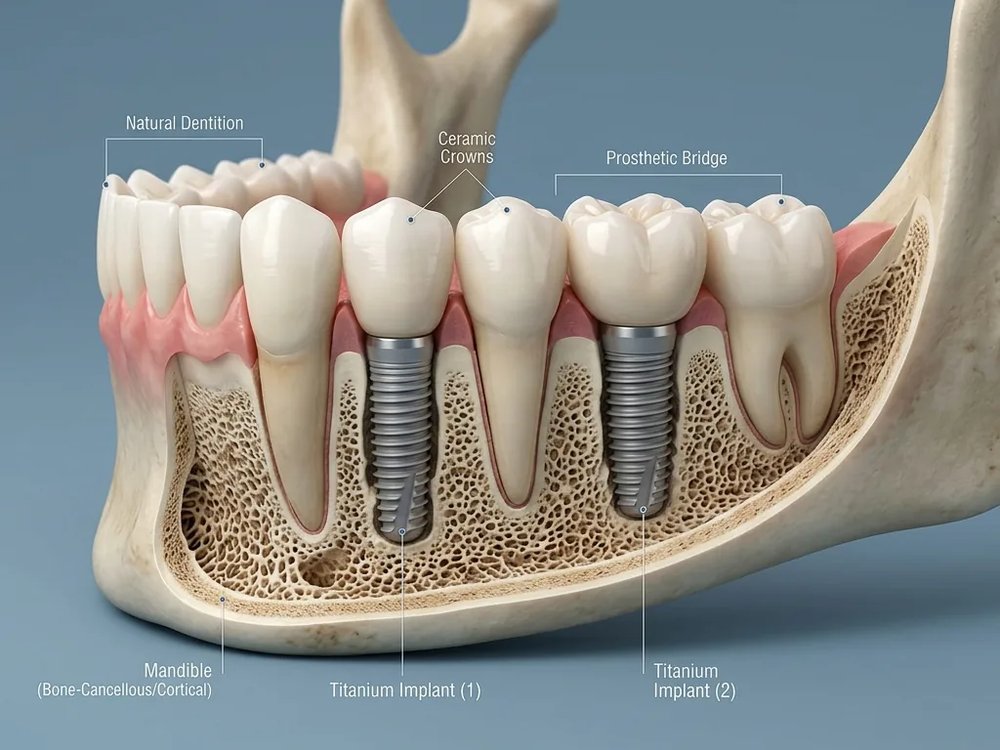
The visible part
What sits on the implant
Implant prosthetics can be divided into two stages of treatment: the implant surgery, which is defined by the prosthetic plan, and the prosthetic restoration itself, that is, making and fitting the new teeth. Implant prosthetics therefore means more than simply anchoring a restoration on the implants. The goal is to position the implants and the restoration – crowns, bridges or whole arches – so that they resemble natural teeth as closely as possible. Implant surgery and implant prosthetics together should achieve teeth that feel and look natural. They must fit precisely and be tailored to each patient's situation.
Before the implants are placed, the prosthetic goal is determined in careful, prosthetically oriented pre-implant planning. The planned result forms the basis for the surgery and defines how many implants are needed, where they are best positioned and when they can be loaded. The aim is a durable restoration that promises lasting, trouble-free function and a pleasing aesthetic result.
A basic precondition for the long-term success of an implant solution is the patient's willingness to maintain adequate oral hygiene. An implant restoration has to be planned and carried out so that it does not overtax the patient's manual dexterity in cleaning and caring for the implants and the restoration.
Diagnostics also supply important information for the prosthetic work. For pre-implant planning, scans can be produced from CT or CBCT images. Reconstructing the teeth and translating that into dental technology can be done with the data from 3D diagnostics and appropriate planning software. Once the data has been processed, the exact conditions of the patient's dentition can be determined. The results are transferred to an articulator, with which the dental technician determines the position of the new teeth among other things. This precise planning allows an optimum restoration tailored to the patient's individual situation, and incorrect loading can be ruled out.
A precisely fitting implant restoration protects against overloading and incorrect loading and reliably prevents implant loss or unfavourable changes in the jaw joint.
A modern route to natural-looking teeth
Backward planning describes an approach to implant restorations in which an individual restoration or acrylic temporary is planned in advance on the basis of a digital, three-dimensional cone beam scan. Analysing the digital data yields precise information about the best possible tooth position. Special planning software is used to select the right implant design and determine the optimum implant position. Computer-assisted planning and placement with the help of a surgical guide allow the implant to be positioned exactly as the prosthetic plan requires. In backward planning the treatment is planned in reverse, starting from the intended prosthetic result. The implants are placed precisely where the plan for the restoration needs them for optimum support and pleasing aesthetics. is a concept for an implant restoration in which an individual prosthesis or temporary made of acrylic is planned in advance on the basis of a digital, three-dimensional cone beam scan. The analysis of the digital data provides precise information about the best possible tooth position. Special planning software is used to choose the matching implant design and to determine the optimal implant position. Computer-assisted planning and implantation with the help of a drilling guide allow the implant to be positioned exactly on the basis of the prosthetic planning. In backward planning, the planning starts from the intended prosthetic restoration and works „backwards“. The implants are placed exactly where the planning of the prosthesis needs them for optimal attachment and an appealing appearance.
The key points at a glance
- Implant prosthetics is the visible restoration attached to the healed implant.
- A single crown can sit on one implant, a bridge or an anchored denture on several.
- The restoration is made individually in the dental laboratory and matched in shape and colour to your own teeth.
Answered briefly