Downloads Video library News FAQs Dental glossary Contact

Placement techniques — one-stage and two-stage healing

Two philosophies shape implantology: one-stage and two-stage healing.

One-stage or two-stage

One-stage healing

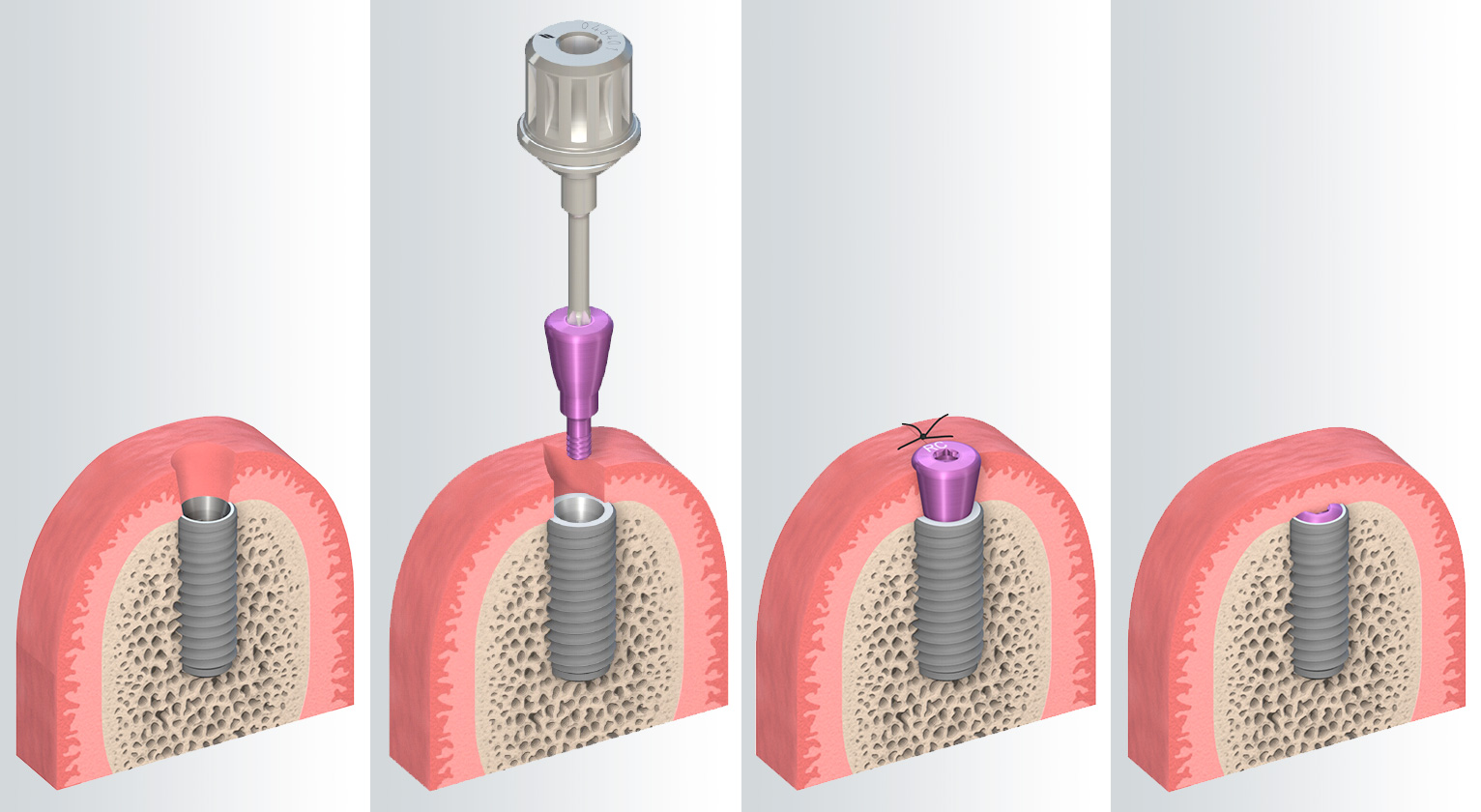
In the one-stage approach implants heal "open": after placement they project above the mucosa while they heal, with the head of the implant above mucosal level. The separate procedure to expose the implant is not needed.

How long a placement takes depends on the difficulty of the procedure and the number of implants. After surgery a patient should not drive or take an active part in traffic for several hours. It is best to be collected or to take a taxi home.
Two-stage healing

Submerged healing gives the implant more protection during the healing process

In the two-stage approach the implant is placed at the level of the exposed bone and the mucosa is sutured over the implant head. After healing, the implant is exposed in a small second procedure so that the prosthetic work can begin. Where placement is combined with bone grafting, the two-stage approach offers protection against external influences.

Schematic view of a healed implant in the jawbone

Two routes

How an implant heals

To see the bone as clearly as possible for placement, the dentist exposes it by raising a mucoperiosteal flap. Where there is plenty of bone, implants can be placed without raising a flap at all (transgingival placement). Special drills prepare the implant site. A surgical guide can help find the exact direction for drilling so that the implant is optimally positioned and aligned. The implant is placed precisely in the jawbone. Primary stability – the first mechanical stability – is one of the key factors for successful healing (osseointegration).

Two different philosophies shape how implants heal. A distinction is drawn between one-stage (open) and two-stage (closed, submerged) healing.

The key points at a glance

  • There are two routes when an implant is placed: one-stage and two-stage healing.
  • One-stage means the implant projects above the mucosa while it heals, and no second procedure is needed.
  • Two-stage means the mucosa is sutured over the implant and reopened later in a small procedure.
  • Primary stability – a firm seat immediately after placement – is one of the most important factors for successful healing.

Answered briefly

Frequently asked questions

The dentist exposes the jawbone, prepares the implant site with special drills and places the implant precisely. Where bone is plentiful this can also be done without raising a flap.
One-stage means the implant heals openly, with its head protruding through the mucosa – a second procedure is not needed. Two-stage means the mucosa is sutured over it and the implant is exposed later.
No, not for several hours. Arrange to be collected or take a taxi home.