Dental implants suit almost every adult
In principle a dental implant can be placed at almost any age. The exception is children and adolescents who are still growing.
After losing teeth, the question arises: which restoration is the best and most sensible solution for me personally? The drawbacks of a conventional bridge and the advantages of an implant solution are often not known. Only after a consultation with the dentist can it become clear what sum you have to allow for your new teeth and what you can expect of them.

Quality of life
Implants bring self-confidence, at any age
In principle dental implants can be placed in adults at almost any age. The exception is children and adolescents who are still growing: growth must be complete before implant treatment. There is no upper age limit.
The basic requirements for placement are, besides normal wound healing and general good health, sufficient bone in both quality and volume. Where the bone volume is not enough to place an implant, new bone formation can be stimulated or the deficit made good with bone harvested from the patient.
Conditions that argue against placing an implant include pronounced metabolic disorders and diseases of the liver, kidneys, blood and bones. Heavy use of nicotine and alcohol likewise endangers success. Good oral hygiene is a fundamental precondition. Periodontal disease must be resolved before implant treatment and the gums must be free of inflammation. Professional tooth cleaning at the practice helps to create a promising starting point. Both before and after the treatment the patient must be prepared to attend regular preventive appointments.
Advantages of an implant restoration
- The jawbone is loaded naturally
- Protection against bone loss
- Long-term, well-documented success rates
- Healthy tooth substance is preserved
- Implants feel like natural teeth
Set against these advantages is the greater investment an implant-supported solution requires. The low cost of a conventional bridge comes with drawbacks of its own. To attach a bridge or crown, the natural neighbouring teeth have to be ground down: healthy tooth substance is destroyed in order to create abutments. Once the bridge is cemented onto them it can no longer be altered. After the bridge has been worn for some time, the bone beneath it can recede for want of loading, and a gap and dark crown margins can appear. The good aesthetic result a bridge gives at first can be considerably diminished by this bone loss and receding gum. Bone loss and incorrect loading can make elaborate follow-up treatment with frequent visits to the dentist necessary.
Taking the example of a single tooth restored with an implant compared with a conventional crown, the cost of the implant restoration begins to pay off after seven years, because its long-term maintenance costs are lower than those of a conventional bridge.
The financial aspect alone should not decide the choice between an implant-supported and a conventional restoration. The question of who dental implants are suitable for should also be answered with an eye to the quality of life they can bring. Whether implants are an option for you can only be decided together with your dentist after a thorough examination. Either the dentist places the implants or refers you to a colleague for the surgery. The prosthetic work – fitting the new teeth – is as a rule always done by your own dentist.
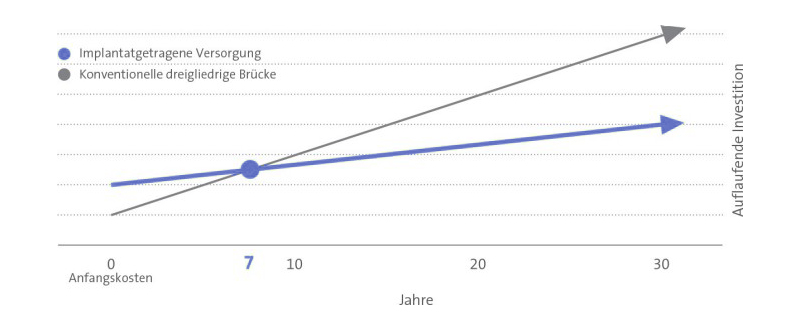
Chart: after seven years a single-tooth restoration begins to pay for itself, because the long-term maintenance costs are lower than those of a conventional bridge.
As comparative studies have shown, conventional prosthetics are not always the most cost-efficient solution in the long run:
- In some situations, where teeth cannot be restored or need only minimal work and sufficient bone is present, an implant solution is to be recommended on economic grounds.¹
- For replacing a single tooth, a single implant is considered a cost-effective treatment option compared with a traditional three-unit fixed bridge.²
- When replacing several teeth, dental implants supporting fixed or removable prosthetics involved higher initial costs than other treatment options but were associated with greater improvements in oral-health-related quality of life.³
¹ Priest GF, Priest JE. The economics of implants for single missing teeth. Dental Economics 2004;94(5):130-138.
² Vogel R, Smith-Palmer J, Valentine W. Evaluating the health economic implications and cost-effectiveness of dental implants: a literature review.
³ Blackwell R, Lowe R, Morris G, Priest G. Implant economics. A supplement to Dental Practice Report, September 2004.
The key points at a glance
- Dental implants are possible in adults at almost any age; there is no upper age limit.
- Implants are not placed in children or adolescents – jaw growth must be complete.
- The requirements are normal wound healing, general good health and sufficient bone; missing bone can often be built up.
- Pronounced metabolic disorders and diseases of the liver, kidneys, blood and bones can argue against placement.
- Heavy use of nicotine and alcohol endangers success; good oral hygiene is a basic requirement.
Answered briefly