Ceramic dental implants are completely metal-free
Ceramic implants are an alternative for patients sensitive to metal or radiation.
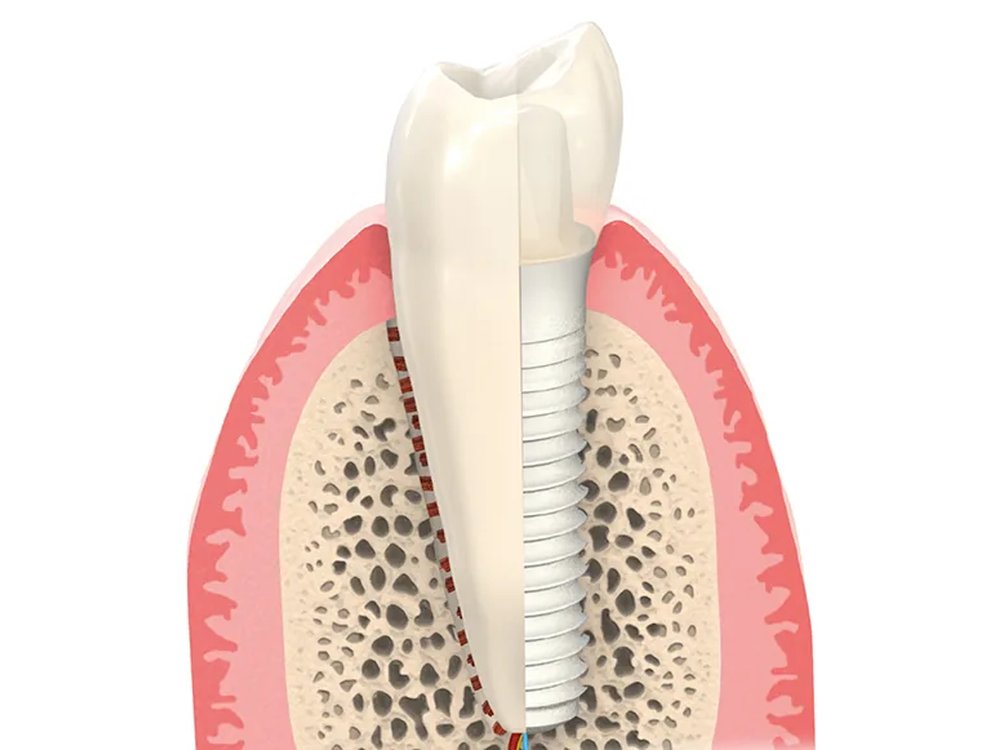
Metal-free
Implants of zirconium dioxide
Sensitive patients are becoming ever more demanding about how well their restorations are tolerated. Countless studies have examined the allergenic properties of many materials used in conventional prosthetics, and a growing group of people reacts sensitively to metal in the mouth. Across wide areas of dental prosthetics, metal-free ceramics such as zirconia have become the material of choice for durable, aesthetically demanding restorations. The use of zirconium dioxide in implantology is relatively new. The material used is a high-performance ceramic that has already proved itself in human medicine in making artificial hip joints. Ceramic is notable for its excellent biocompatibility, its tissue tolerance and its biological neutrality. Because of its mechanical properties – high flexural strength and dimensional stability – zirconium dioxide is now used in implantology as well. Zirconia implants (PURE Ceramic Implant) are completely metal-free and offer patients with immunological sensitivities an alternative to titanium implants. For patients sensitive to metal or radiation, zirconia implants are a new restoration option.
Where patients have a thin gingival biotype (thin attached gingiva, a risk to the formation of the papilla, implants more easily visible through the mucosa) or suffer from soft-tissue recession, ivory-coloured zirconia implants are a promising alternative to titanium in aesthetic terms. Zirconia implants have excellent tissue tolerance, are biocompatible and behave in a biologically neutral way. In critical situations an implant solution can dispense with metal altogether. For successful implant treatment, how predictable the result is matters greatly. Ceramic implants (PURE Ceramic Implant) are placed using the same established protocol and surgical technique as titanium or Roxolid® implants.
Ceramic implants must have a surface whose osseointegration properties are comparable with those of a proven titanium implant. The same healing pattern, the same healing time and the same preservation of bone are required of them.
Ceramic implants stand for good tolerability
The gum responds very well to ceramic implants, as they are less prone to plaque. Thanks to their excellent tissue tolerance, the gum generally regenerates very well around the implant. The risk of gum inflammation or of the dreaded peri-implantitis should be reduced.
Studies have reported implant fractures with all-ceramic implants from various manufacturers. Where implants are made of high-performance zirconium dioxide (Y-TZP), the risk of fracture is considerably reduced.
The key points at a glance
- Ceramic implants are made of zirconium dioxide and are metal-free – an option for patients who react sensitively to metal.
- The gum responds well to ceramic because it is less prone to deposits.
- That should reduce the risk of gum inflammation and peri-implantitis.
- Made of high-performance zirconium dioxide (Y-TZP), the risk of implant fracture is considerably lower.
Answered briefly