Cone beam CT — cross-sectional images of dental anatomy
Cone beam computed tomography (CBCT) is a further development of computed tomography.
Cone beam computed tomography (CBCT) is a further development of computed tomography. CBCT captures the dental and facial anatomy in three dimensions and produces a virtual image of the patient. A single scan can be displayed from different viewpoints (axial, coronal and sagittal). The smallest details of the bony facial skeleton can be visualised and analysed precisely.
Cone beam computed tomography produces cross-sectional images from a series of radiographic exposures. The unit takes these exposures as it travels around the patient's head. They allow a wide range of views on the computer. Cross-sections of the jaws and individual structures can be viewed in razor-sharp 3D and measured exactly. The three-dimensional, plastic image supports diagnosis, planning and implant placement in critical situations. In pre-operative implant diagnostics it can reveal findings that conventional imaging techniques often cannot show.
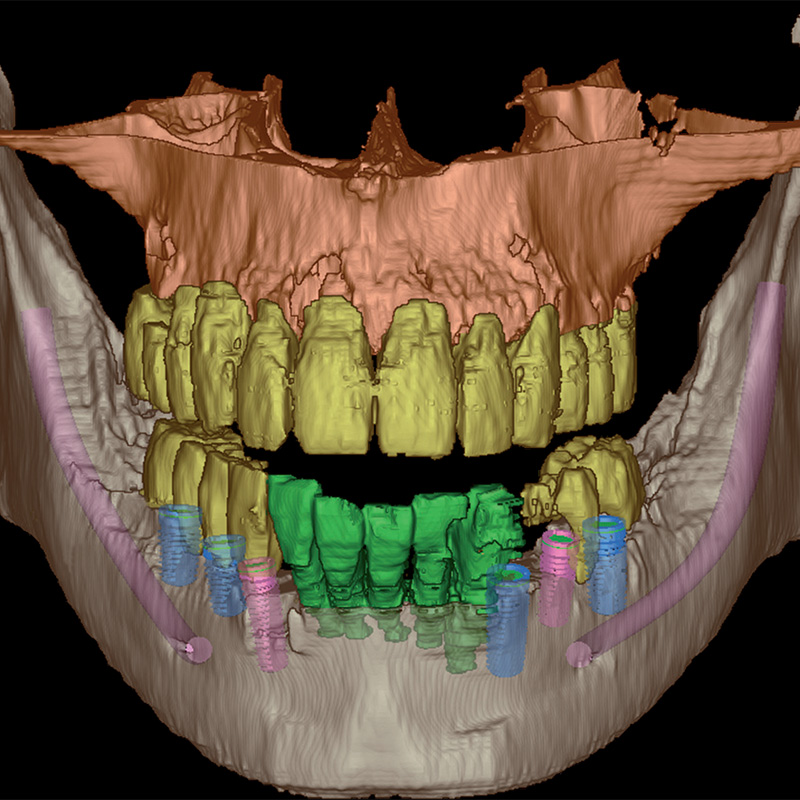
Implant diagnostics
The bone available, its quality and any individual peculiarities are known before the procedure begins. On the computer the dentist can move through the bone before the operation and determine the length, the angle, the implant type and the ideal position on screen. The entire procedure can be planned virtually down to the last detail.
The course of the nerve in the lower jaw, the sinus floor in the upper jaw and the roots of the adjoining teeth can all be imaged exactly. The advantage of cone beam computed tomography is a markedly lower radiation dose than conventional computed tomography while offering very high resolution. A CBCT scan needs a fraction of the dose of an older technology such as CT.
As new techniques are introduced, treatment concepts can become ever less invasive. The development of digital pre-implant diagnostics has widened the possibilities for planning and carrying out an implant restoration.
The cost of a CBCT scan
Cone beam computed tomography is not reimbursed by statutory health insurers. The technique is only recommended where, in complex or unclear situations, it helps to make implant placement easier to plan and to avoid possible risks.
A CBCT scan usually costs between €120 and €250. This covers taking the image (digital capture) and analysing it.
Answered briefly