Protecting your teeth against peri-implantitis
Caring for your implant-supported teeth protects against peri-implantitis.
Implants cannot fall ill, but they can be lost if oral hygiene is inadequate. An implant needs an environment that is as clean and free of bacteria as possible. Bacterial inflammation of the mucosa around the implant endangers the long-term success of implant treatment.
Just as natural teeth are at risk of periodontitis when care is lacking, so-called peri-implantitis can develop around implants after successful healing and osseointegration if oral hygiene is insufficient. This peri-implant inflammation is the most common cause of late complications and can, in the worst case, lead to the loss of an implant.
Once the implant has been placed and has osseointegrated, regular check-ups and professional tooth cleaning protect against peri-implantitis and mucositis.
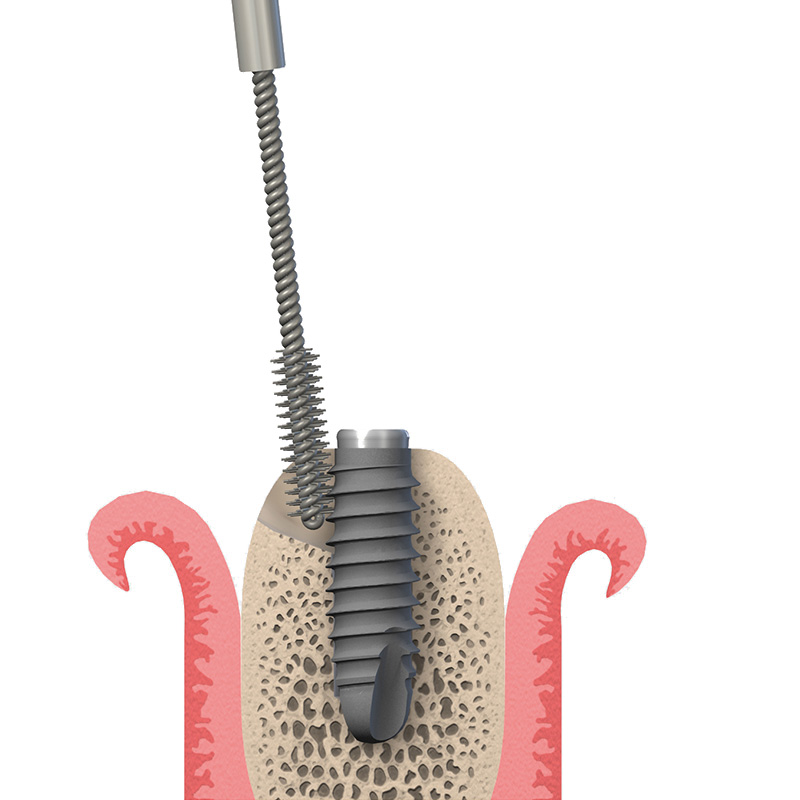
Preventing peri-implantitis
At the time an implant is placed, patients are often unaware that the tissue around it can become inflamed. This peri-implant inflammation is the most common cause of late complications and can, in the worst case, lead to the loss of an implant. Only prevention protects against it. When the tissue around an implant becomes inflamed, there is a risk of mucositis and subsequently of peri-implantitis.
Prevention protects against these infections and begins before the implant is even placed. Good oral hygiene and correspondingly healthy gums and teeth are a precondition for planning successful implant treatment. Once the implants have healed, that success can only be secured by appropriate oral hygiene. Care at home has to be complemented by regular check-ups and professional prevention at the dental practice. During a preventive implant appointment, deposits, bacterial colonisation (plaque) and the pathogenic biofilm are removed from the parts of the implant that are hard for the patient to reach.
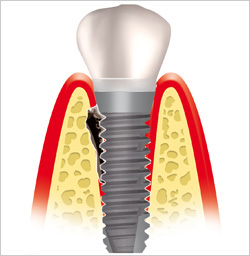
Signs of peri-implantitis
Mucositis
Mucositis is comparable to gingivitis, an inflammation of the gum. It causes bleeding, but the bone is not yet affected and there are no signs of bone loss.
Peri-implantitis
The earlier peri-implantitis is diagnosed, the better the chances of treating it successfully. Diagnosed in good time, the dreaded loss of bone around the implants can be prevented. Explaining this to the patient plays a particular part.
The first signs of peri-implantitis are redness, bleeding and swelling of the gum around the implant. The symptoms are hard for patients to spot because they are mostly painless. At the outset the infection is still confined to the soft tissue. A peri-implant pocket of more than 4 mm forms and the connective tissue is damaged. The inflammation causes a creeping, continuous loss of several millimetres of the bone adjoining the implant, and finally the implant loosens.
Treatment
In the initial phase the bacteria and the germs causing the inflammation are removed from the implant surface and the contaminated surface is then disinfected. Rough areas and deposits on the implant are removed, along with any niches where dirt can collect, to prevent plaque from settling again. A smoothed implant surface is easier to keep clean and should lead to a reduction in the peri-implant inflammation.
For further cleaning, ultrasonic systems optimised for peri-implantitis treatment with modified tips can be used. Biofilm removal can be supplemented by air-polishing units using low-abrasion powder. An additional laser therapy can eliminate bacteria reliably. This mechanical cleaning of the implant surface can be supported by antibiotics in order to reduce the bacterial load on the titanium surface and treat the acute inflammation. Antibiotics have no effect, however, on the underlying cause of the peri-implantitis.
The patient has to be willing to improve their implant care, since inadequate care is the greatest risk factor for peri-implantitis. Problems can only be avoided with a structured aftercare concept and a systematic, closely spaced recall.
Open surgical procedure
After these antiseptic measures, further steps – as minimally invasive as possible – can follow. Where bone has been lost, additional surgery is required. In this open surgical procedure, treatment of the implant surface can be combined with regenerative techniques in order to make good the loss of bone. These regenerative measures work with bone substitute materials which, protected by membranes, are intended to encourage new bone to attach. The aim of the therapy is a situation without clinical signs of inflammation, the preservation of implant function, and a band of attached mucosa around the implant.
Implants – an investment in quality of life
The goal of every implant treatment is a natural, firmly seated restoration that has healed securely and cannot be told apart from natural teeth.
Conscientious oral hygiene is the precondition for enjoying implants over a long period. Natural teeth and new implant-supported teeth alike are best brushed after every substantial meal. The aim of thorough care is the gentle removal of soft plaque and of calculus as it begins to form.
Once the implants have healed, the success of the treatment can only be secured by appropriate oral hygiene. Care at home has to be complemented by regular check-ups and professional prevention at the dental practice. During a preventive implant appointment, deposits, bacterial colonisation (plaque) and the pathogenic biofilm are removed from the parts of the implant that are hard for the patient to reach.
Older people and those in need of care, whose dexterity is limited and whose eyesight is failing, need support from their carers and those around them in cleaning and caring for their implant-supported restorations.
Answered briefly